Some links may be affiliate links. We get money if you buy something or take an action after clicking one of these links on our site.
Christmas All The Time is a participant in the Amazon Services LLC Associates Program, an affiliate advertising program designed to provide a means for sites to earn advertising fees by advertising and linking to Amazon.com. As an Amazon Associate, I earn from qualifying purchases.
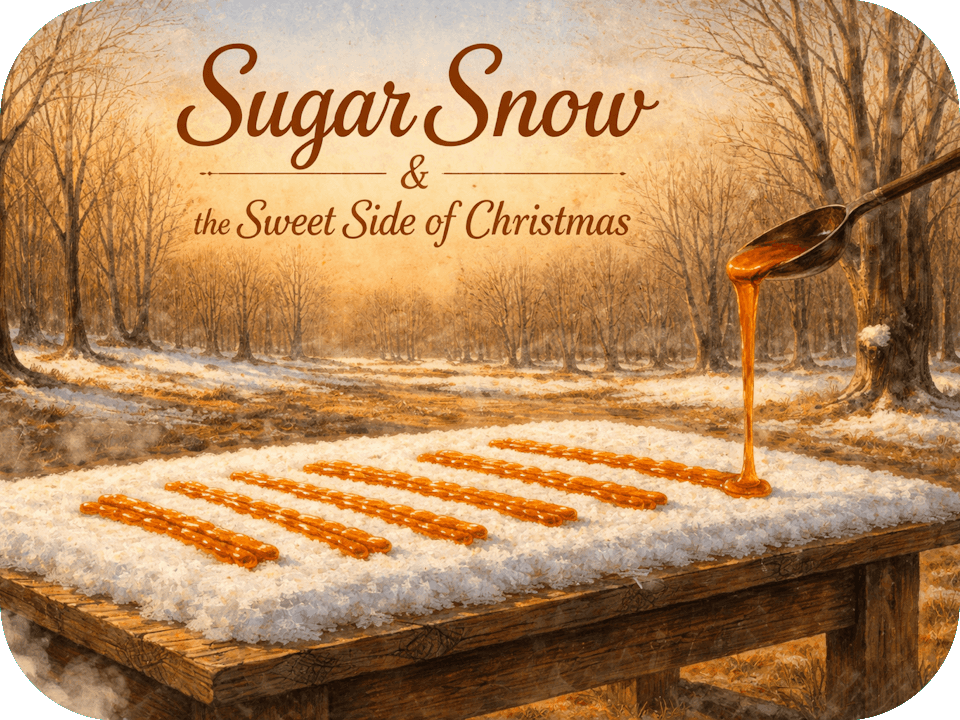
Sugar Snow & the Sweet Side of Christmas
In early March, when winter still lingers in the hedgerows and the thaw has only begun to loosen the soil, Americans have long turned their attention to one of the quietest seasonal pleasures: the gathering of sweetness. Snow still lies in pale drifts across fields and hillsides, but inside kitchens and sugar shacks the air carries the warm scent of boiling syrup and fresh sugar.
Long before Christmas arrives with its bright lights and evergreen wreaths, the American year begins laying the foundations of its winter celebrations. The rhythms of work and home life—planting, harvest, cooking and preserving—gradually shape the customs that will later appear on the Christmas table. Some of the most beloved holiday sweets trace their story not to December kitchens but to the cold, patient work of early spring.
Among these traditions is the making of what rural families once called sugar snow: warm maple syrup poured over fresh snow to create a simple confection. Children gathered around wooden buckets and tin ladles. A mother or grandfather poured the hot syrup in ribbons across the packed snow, where it hardened into sweet amber taffy.
The scene feels unmistakably American—snow underfoot, steam rising from a kettle, laughter drifting through bare maple trees—and it reminds us that the path to Christmas often begins long before Advent candles are lit.
Maple Kettles & Snow Tables
The house was so full of Christmas that it was like a great warm box filled with happiness. ~Laura Ingalls Wilder, Little House in the Big Woods
The roots of maple sugaring in North America reach far deeper than the early United States. Indigenous peoples of the northeastern woodlands had long known the gift hidden inside the maple tree. As winter loosened its hold and the days warmed above freezing, sap began to rise through the trunks. By tapping the trees and boiling the collected sap, they created a concentrated sweetness that could be stored or traded.
European settlers arriving in the forests of New England and the upper Great Lakes quickly adopted the practice. Unlike cane sugar imported from distant plantations, maple sugar could be made close to home. It required little more than patience, firewood and the steady drip of sap from a forest of trees.
In the eighteenth century, sugaring time became one of the most distinctive seasonal rituals of northern rural life. Families carried wooden buckets through snowy groves, gathering the clear sap that slowly filled them. At a central fire, iron kettles hung over flames as the liquid boiled down into thick syrup.
One traveler in the early republic described the scene with quiet admiration:
“The forests in the sugaring season appear animated with cheerful industry, kettles boiling among the trees and children tasting the sweet foam as it rises.”
Once enough syrup thickened, the children waited for the moment everyone knew was coming. A pan of clean snow was packed flat—sometimes on a wooden table set outside the sugar house—and the syrup was poured across it in narrow lines. In seconds the syrup hardened into soft taffy that could be lifted with a stick or fork.
These “sugar-on-snow” gatherings were simple affairs: steaming kettles, wooden benches, mittened hands and the scent of maple drifting through cold air. Yet they were also celebrations of abundance at the tail end of winter—a reminder that sweetness had returned to the land.
Sugar Shacks & Family Gatherings
How to make Sugar on Snow | Maple Taffy | Pure Maple Syrup Candy #diycandy #maplesyrup #familyfun
As the young United States expanded north and west through the nineteenth century, maple sugaring became woven into the rhythms of American home life. Farms in Vermont, New York, Pennsylvania and the upper Midwest counted the maple grove as one of their most dependable seasonal resources.
By the mid-1800s the sugar camp—or “sugar shack”—was a familiar structure in many rural communities. Built close to stands of maple trees, these small wooden buildings housed the long evaporating pans where sap boiled day and night during the brief sugaring season.
The work itself demanded attention. Sap had to be collected daily from the trees, hauled to the shack and poured into the pans. Fires burned steadily beneath the evaporators. Steam rose through the roof vents, drifting like pale clouds among the branches.
But despite the labor, sugaring time was rarely remembered as drudgery. It was often one of the few agricultural seasons that invited neighbors and extended family to gather.
Children helped gather sap in small pails, their boots crunching across frozen ground. Mothers prepared hearty meals—baked beans, fresh bread and thick slices of ham—to feed the workers. When evening arrived and the kettles simmered low, someone inevitably packed fresh snow into a pan for the traditional treat.
Visitors came not only for syrup but for the fellowship of the season. Sleighs might arrive carrying cousins from the next town. Lantern light glowed through the shack windows while the woods stood quiet and dark beyond.
The sugar-on-snow treat itself became a beloved moment. Hot syrup streamed across the snow, curling into golden ribbons. Sometimes a bowl of dill pickles or sour apples was passed around to balance the sweetness—a curious but enduring pairing that still appears at traditional sugaring festivals today.
Over time these gatherings helped turn maple sugaring into more than a farm task. It became a seasonal celebration, a way of marking the turning of the year with warmth, laughter and the promise of spring.
Snow Candy & Christmas Kitchens
If you bake me homemade Christmas cookies, I’m always going to think you are a wonderful person. Full stop. ~Carla Hall
Though maple sugaring belongs to early spring, its sweetness travels quietly through the rest of the year. Syrup and maple sugar stored in stone crocks or tin containers became staples of American kitchens, shaping the flavors that later appeared at Christmas.
In many nineteenth-century households, maple sugar served as an everyday sweetener. It flavored oatmeal and cornbread. It was shaved into tea or melted into sauces. And as the year drew toward winter again, it found its way into holiday baking.
Christmas kitchens across northern states often featured maple candies, maple fudge and glazed pastries sweetened with syrup gathered months earlier in the snowy woods. Even where cane sugar grew more common, the warm flavor of maple remained a cherished reminder of homegrown abundance.
Children who had once chased sap buckets through the maple grove now gathered around winter tables dusted with flour and sugar. Wooden spoons scraped thick maple mixtures from iron kettles. Trays of candy cooled near frosted windows.
In some households the old sugar-on-snow tradition quietly reappeared during winter festivities. A pan of clean snow brought indoors could turn a pot of heated syrup into a simple holiday treat—one that felt as magical in December as it had months earlier beneath the trees.
What makes this tradition so enduring is not its complexity but its simplicity. It requires only a few elements: snow, warmth, sweetness and a gathering of people who share the moment.
And in that way it reflects something deeper about the American path to Christmas. The holiday is rarely built in a single day or even a single season. It grows slowly from the ordinary rituals of the year—meals prepared together, work shared among family and the quiet pleasure of turning simple ingredients into something joyful.
When winter returns and Christmas lights appear along porches and town squares, those earlier moments still linger in memory. The scent of maple steam in March, the sparkle of snow beneath bare branches, the laughter around a sugar table—all of it carries forward into the spirit of the season.
The sweetness gathered in early spring becomes part of the warmth we feel when Christmas finally arrives.
And so the American journey toward Christmas continues, season by season—sometimes beginning not with pine and candlelight, but with sugar snow and the first taste of sweetness after winter.
 And when December finally returns—with its candlelight, its evergreen boughs, its tables set for celebration—it carries with it the memory of these earlier, quieter sweetnesses.
The sugar that gleams in a Christmas confection, the candy cooling on a winter windowsill, the careful hands shaping treats in a warm kitchen—all of it has its roots in those lingering days of March. In the pale snow of early spring, in the slow boil of sap over an open fire, in the first shared taste of something sweet after a long winter.
The American Christmas is not made in a single season. It is gathered, patiently, across the year.
It begins in the cold, with snow and fire and rising steam. It passes through kitchens and hands and memory. And by the time the holiday arrives, what we celebrate is not only the sweetness on the table, but the long, quiet work of bringing it there.