Some links may be affiliate links. We get money if you buy something or take an action after clicking one of these links on our site.
Christmas All The Time is a participant in the Amazon Services LLC Associates Program, an affiliate advertising program designed to provide a means for sites to earn advertising fees by advertising and linking to Amazon.com. As an Amazon Associate, I earn from qualifying purchases.
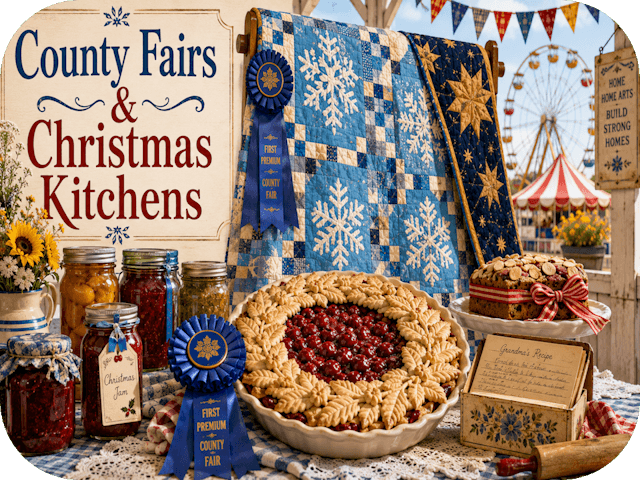
County Fairs & Christmas Kitchens
Christmas kitchens are made in December, but their story begins much earlier.
Before there are gingerbread houses on the counter or pies cooling for Christmas dinner, there are berries to preserve, peaches to put up, apples to gather and recipes to practice. In much of American life, particularly where the household year remained close to the agricultural year, summer abundance was not simply enjoyed in summer. Some of it was deliberately carried forward.
That makes the county fair a surprisingly natural stop on our yearlong journey toward Christmas.
Walk through the domestic exhibits at a traditional fair and the connection begins to appear. There are pies beneath glass covers, neat rows of preserves, quilts spread to show their stitching and blue ribbons pinned beside somebody’s best work. The livestock barns may tell the story of the farm, but the exhibition hall tells another story: what Americans did with what the farm and garden provided.
Those skills did not remain at the fairgrounds. They went home to pantry shelves, recipe boxes and kitchen tables. By Christmas, some of summer’s work would return in a very different season.
In August, then, we can glimpse the Christmas kitchen while it is still being made.

Blue Ribbons & Recipe Cards
They bring us together, and thereby make us better acquainted, and better friends than we otherwise should be. ~Abraham Lincoln, Wisconsin State Agricultural Society in 1859
The American agricultural fair grew from a desire to bring people together to compare their work and learn from one another. Elkanah Watson’s cattle show in Pittsfield, Massachusetts, in 1811 helped establish the model that spread through agricultural societies across the young country. Competition was part of the idea from the beginning: excellent work should be displayed, recognized and imitated.
By the middle of the nineteenth century, fairs were becoming familiar institutions across rural America. The competitions extended beyond livestock and crops to the work of the household. Baking, sewing and other domestic skills joined the displays of agricultural accomplishment. The fair became a place where the work normally performed in kitchens, gardens and sewing rooms could be brought into public view.
Lincoln was speaking about agricultural fairs broadly, but his observation captures something essential about the institution. The fair was not merely a contest. It was an exchange. People brought what they knew, saw what their neighbors knew and carried ideas home again. Lincoln went on to describe fairs as a means for the “mutual exchange” of knowledge so that something known to one person might eventually become known to many.
That principle worked as readily at a pie table as beside a prize bull.
A particularly good loaf, preserve or cake represented more than a ribbon. Someone had learned how to make it well. Someone else might ask about it. A daughter might remember how her mother prepared it. A recipe might be copied onto a card and tucked into a box.
And some of those recipes would become holiday recipes.
Christmas food traditions rarely arrive in a household fully formed. They accumulate. A pie becomes “the pie we always have.” A particular jam appears with the biscuits every Christmas morning. A cake that once won praise at a summer fair becomes the cake requested when the family comes home in December.
The fair provided one of the places where American families could display, compare and preserve that domestic knowledge.
The blue ribbon eventually faded. The recipe remained.
Canning Jars & Pantry Shelves
HOMEMADE CHRISTMAS GIFT AND GIFT IN A JAR IDEAS | 2024
By August, the American garden can seem almost too generous.
Beans arrive by the basket. Cucumbers hide under broad leaves. Peaches soften faster than a family can eat them. Berries demand attention immediately. The kitchen becomes a workshop of kettles, jars, towels and produce waiting its turn.
For generations of households, preserving that abundance was part of the ordinary work of the year. The county fair turned that private labor into something worth displaying.
Canning and food-preservation categories remain part of American fairs today. Fair books list jams, jellies, fruit butters, pickles, relishes, canned fruits and vegetables. Modern competitions appropriately require current, research-tested preservation methods, but the familiar sight remains: orderly glass jars holding the colors of the growing season.
The connection between fairs and household education became especially visible through the Cooperative Extension movement and youth programs in the twentieth century. Early Boys’ and Girls’ Clubs, predecessors of 4-H, included projects in gardening, sewing and canning. Children learned techniques and carried that knowledge back into their households.
That exchange between fairground and kitchen continues. Extension programs still teach food preservation at fairs, sometimes with live demonstrations showing visitors how summer produce can safely become food for another season.
A useful glimpse into that tradition is this Kansas State University Extension presentation on judging food-preservation entries. It shows that the jars on a fair shelf represent more than appearance: they reflect learned techniques, food science and standards passed from one generation of home preservers to another.
For our journey toward Christmas, however, there is another reason to linger beside those jars.
A jar is summer deliberately saved for later.
The strawberries do not know they may eventually be spooned over Christmas breakfast. The peaches do not know they may become a winter cobbler. Apples preserved as butter or sauce have no calendar hanging beside the kettle.
The people filling the jars do.
Not every preserved food was destined for a holiday table, of course. The pantry served the household throughout the cold months. But the habits behind it — preparing ahead, saving abundance and making something with one’s own hands — fit naturally into the domestic culture surrounding an American Christmas.
By late summer, Christmas may still seem distant.
On the pantry shelf, part of it may already be waiting.

Fair Pies & Christmas Tables
…once more to assemble about the paternal hearth, that rallying-place of the affections… ~Washington Irving, Old Christmas
There is a lovely transformation between the county fair table and the Christmas table.
At the fair, the pie is presented for judgment. Its crust is examined. Its filling is considered. Perhaps a ribbon is placed beside it.
At Christmas, nobody needs to judge it.
Now the pie belongs to the family.
The recipe that once demonstrated skill becomes part of hospitality. Preserves are opened. Breads are sliced. Cookies fill tins. Familiar dishes return because somebody remembers them and somebody takes the time to make them again.
This is where the summer fair and the Christmas kitchen finally meet.
Washington Irving, one of the writers who helped shape the American imagination of Christmas in the nineteenth century, understood the holiday table as something larger than food. In his Christmas writings, meals, hearths and hospitality become ways of drawing people together. The National Endowment for the Humanities notes the considerable influence Irving’s vision had on the developing American Christmas tradition.
It is a wonderfully compact description of what generations of Christmas kitchens have attempted to do.
The food matters, certainly. We remember the smell of a particular pie and the tin in which an aunt kept her cookies. We remember flour on the kitchen table, steam on the windows and somebody insisting that the recipe must be followed exactly because that is how Grandma made it.
But the food matters partly because of whom it gathers.
That is something the county fair understood, too.
The fair brought neighbors together to show what they had raised, grown, stitched, baked and preserved. Christmas brings families and friends together to share what has been prepared for them. Both traditions turn ordinary domestic work outward. Skill becomes generosity. Abundance becomes hospitality.

Perhaps that is why the path from an August fairground to a December kitchen is shorter than it first appears.
The Ferris wheel will come down. The livestock barns will empty. Blue ribbons will be carried home and tucked into drawers. Before long, autumn leaves will replace the fairground dust, and then frost will settle over the fields.
But jars will remain on pantry shelves. Recipe cards will remain in their boxes. Someone will remember which pie everybody liked.
And as the American year continues its long turn toward Christmas, the work displayed so proudly beneath the fairground pavilion will find its way back to the place where much of it began: a warm kitchen, a crowded table and people glad to be home together.