Some links may be affiliate links. We get money if you buy something or take an action after clicking one of these links on our site.
Christmas All The Time is a participant in the Amazon Services LLC Associates Program, an affiliate advertising program designed to provide a means for sites to earn advertising fees by advertising and linking to Amazon.com. As an Amazon Associate, I earn from qualifying purchases.
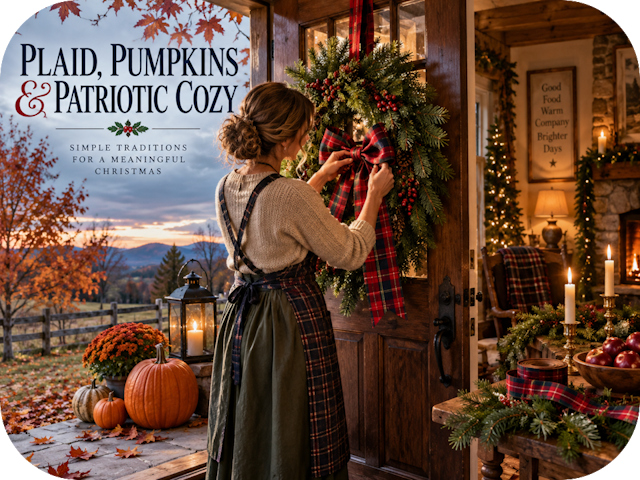
Plaid, Pumpkins & Patriotic Cozy
October brings a comfortable turn toward Christmas. Plaid comes out of the closet, kitchens grow warmer and porch lights shine earlier each evening. Pumpkins may still guard the front steps, but these familiar autumn comforts are already preparing the American home for the season of gathering ahead.
Plaid Ribbons & Christmas Greens
Plaid and pine are timeless elements that evoke a sense of tradition, luxury, and country-house charm. ~Chelsea King
Plaid has a remarkable ability to become Christmas the moment it meets a sprig of pine.
Its roots, of course, reach far beyond American Christmas. Checked and tartan woolens arrived with European textile traditions and found a natural place in a country where warm, durable cloth belonged to everyday winter life. Shirts, blankets, scarves and coverlets brought pattern and color into homes during the bleakest months of the year.
Over generations, those familiar winter fabrics became part of America’s Christmas vocabulary.
A red plaid ribbon tied around an evergreen wreath feels at home on a farmhouse door. A wool blanket beside the Christmas tree suggests an evening spent near the fire. Checked wrapping paper, stockings and table linens borrow the visual language of practical winter cloth and turn it toward celebration.
That transformation is characteristic of American Christmas decorating. Ordinary things are often welcomed into the holiday rather than displaced by it. Pinecones gathered outdoors join ribbons and candles on the mantel. A basket that held apples in October may hold evergreen branches in December. The red plaid blanket does not have to go anywhere at all.
This is where October begins contributing to Christmas without becoming Christmas prematurely. A porch rocker with a plaid throw, a wooden door and a few pumpkins nearby is unmistakably autumnal. Add an evergreen wreath several weeks later and the same setting has crossed naturally into the Christmas season.
The house has not changed character. It has simply continued along the road.
Hearth Fires & Holiday Tables
30 Forgotten 10 Min Christmas Recipes You Could ONLY Find In Old Cookbooks!
American Christmas has always been as much a household season as a calendar date.
For earlier generations, autumn preparation was practical. Food was preserved, firewood stacked, bedding aired and winter clothing brought back into use. Kitchens that had processed the harvest would soon turn their attention toward Thanksgiving and then Christmas.
The ingredients changed, but the domestic rhythm continued.
That continuity helps explain why Christmas cooking carries such emotional weight. Holiday recipes are rarely just instructions. They belong to people. Grandma made this pie. Dad always burned those cookies. An aunt brought that casserole every Christmas Eve. Someone’s handwriting survives on an index card long after the original cook is gone.
October gently wakes that part of the household.
Apples bake. Cinnamon comes down from the cupboard. Soup simmers longer. Perhaps a pumpkin becomes bread or pie, but it shares the kitchen with the first thoughts of Christmas cookies, fruitcake, candy, holiday breakfasts and the dishes that will eventually crowd the family table.
The hearth performs much the same transition. Once the first genuinely cold evening calls for a fire, the room begins to resemble the place where Christmas will happen. Chairs gather around it. Blankets accumulate. The mantel suddenly becomes noticeable again.
Soon enough, evergreen will rest there.
American Christmas coziness grows from that ordinary domestic preparation. The holiday table feels welcoming because the home has spent weeks turning inward, warming itself and rediscovering the pleasures of feeding people.
October opens the kitchen door. Christmas eventually fills the chairs.
Lantern Light & Evergreen Doors
There are few things as soothing and peaceful as a home all lit up by Christmas lights. ~Rachel Paxton
Then the light begins to change.
October evenings arrive noticeably earlier. Porch lamps come on before supper. Candles once again seem appropriate on the table. Windows glow against darkness while the landscape outside becomes barer with every passing week.
This may be autumn’s clearest contribution to the atmosphere of Christmas.
For much of American history, winter light was precious. Hearths, candles and lamps created small islands of brightness around which household life gathered. Christmas inherited that contrast and made it celebratory: candles in windows, illuminated churches, glowing trees and lanterns welcoming visitors through the dark.
The symbolism is older and deeper than decoration alone. Christmas arrives near the darkest days of the year proclaiming light, hope and glad tidings. The American home expresses those ideas in wonderfully tangible ways. A candle shines through a window. A church door opens onto a cold evening. Lanterns mark the path toward a neighbor’s house. Evergreen on the door promises life in a landscape settling into winter.
October prepares our eyes for those things.
At first there may be pumpkins beneath the porch lantern and chrysanthemums beside the steps. Then Thanksgiving passes. The pumpkins disappear, pine and holly take their place and perhaps that same plaid ribbon appears around the wreath.
The porch has traveled from harvest to Christmas without losing its sense of home.
Plaid, pumpkins and lantern light need not pretend that Christmas has already arrived. They simply make the house cozy while autumn carries us toward it.
For now, there may still be a pumpkin beside the door.
The evergreen will come soon enough.