Some links may be affiliate links. We get money if you buy something or take an action after clicking one of these links on our site.
Christmas All The Time is a participant in the Amazon Services LLC Associates Program, an affiliate advertising program designed to provide a means for sites to earn advertising fees by advertising and linking to Amazon.com. As an Amazon Associate, I earn from qualifying purchases.
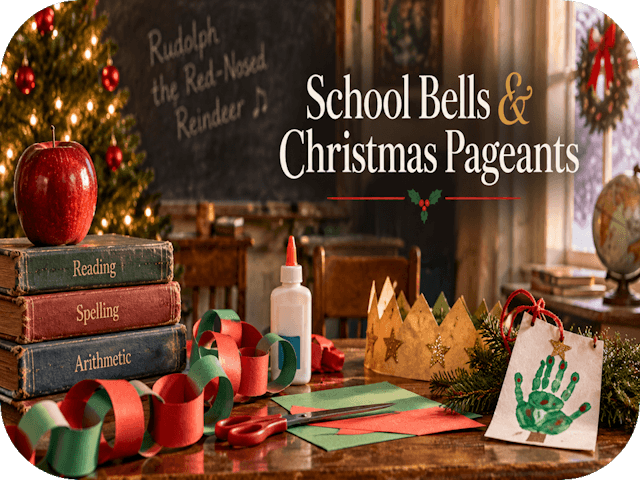
School Bells & Christmas Pageants
September does not look much like Christmas. The trees are still green, the school year is just beginning and December seems comfortably far away.
But somewhere between the first school bell and the last bell before Christmas break, Christmas finds its way into the classroom. For generations of American children, some of the season’s most enduring memories have begun there.

Christmas Comes to School
As a child, I used to love to make paper chains to decorate our Christmas tree. ~Laura Candler
Christmas celebrations in American schools grew from traditions already present in community life. Early schools were often closely connected with churches and religious communities, while public recitations and school exhibitions gave children opportunities to demonstrate what they had learned before parents and neighbors.
As Christmas became increasingly prominent in American life during the nineteenth century, it naturally entered those gatherings too. Children could recite seasonal verses, sing familiar carols or present simple scenes before their families.
The Christmas arriving in the classroom reflected the Christmas taking shape throughout the country: Christian observance joined with family celebration, music, storytelling, generosity and a growing emphasis on childhood. Churches and Sunday schools also developed Christmas programs for children, helping establish the familiar combination of recitations, carols, pageantry and seasonal giving.
The schoolroom added its own character. A small tree might be decorated with handmade ornaments. Greenery could brighten a blackboard or window. Children learned Christmas songs together and practiced readings that would later be presented to their families.
Schools also brought children from different family traditions into one room. A carol learned there could travel home to a household that had never sung it before. A Christmas custom familiar to one child could become new to another. Family traditions followed children into the classroom while classroom traditions followed them home.
Over generations, that exchange helped create a shared American Christmas vocabulary without making every family’s Christmas exactly alike.
Cardboard Crowns & Christmas Carols
“Why the Chimes Rang: A History of the CFS Christmas Pageant”
For many families, the most memorable school Christmas tradition was the program.
There were Nativity plays and Christmas pageants, choir and band concerts, recitations and assemblies. Some centered on the birth of Christ. Others combined carols, poems, winter scenes and familiar Christmas stories. Whatever form they took, preparation itself became part of the season.
Scripts came home with certain lines underlined. Children practiced songs until the entire household knew them. Parents discovered that someone needed a white shirt, an angel costume or something that could plausibly make a nine-year-old look like a shepherd by Thursday evening.
American household ingenuity took over from there.
Bathrobes became Biblical garments. Bedsheets became angel robes. Cardboard became crowns. Aluminum foil supplied improbable quantities of royal gold and silver. A shepherd’s staff might begin life as a branch from the backyard. Classroom tables disappeared beneath construction paper, paste, paint and paper stars destined for the stage.
The performances themselves were seldom elegant, which was part of their charm. Joseph forgot his line. A halo slipped over one eye. Someone sang enthusiastically in the wrong key. A cardboard star developed an alarming list to port.
Parents watched from folding chairs because their children were there.
Yet amid the homemade scenery and crooked costumes, children encountered some of the oldest elements of Christmas. Bethlehem became a painted backdrop. Shepherds could be classmates. The journey of the Wise Men could be acted out beneath a star cut from poster board. A familiar carol suddenly meant standing on choir risers and watching the music teacher for the cue.
For Christian families, the pageant gave children a tangible encounter with the Nativity story at the heart of Christmas. More broadly, school programs gathered families around music, storytelling and the pleasure of watching children offer their own imperfect contribution to the season.
Across generations, the programs changed.
The cardboard crowns somehow endured.

Christmas Comes Home
Gifts made with love and with a loved one in mind make both the gift-giver and the gift-receiver feel all hot-chocolaty warm inside. ~Jessica Boschen
The school Christmas did not remain at school.
Children came through the front door carrying paper bags, folders and oddly shaped packages accompanied by stern instructions that Mom was absolutely not allowed to look.
Inside might be a handprint ornament, paper angel, clothespin reindeer, painted wooden shape or some other creation made with more affection than structural integrity. A classroom Christmas party might send a child home with a new recipe, game or decorating idea. A song rehearsed for weeks had usually become familiar to everyone within earshot long before the concert occurred.
And somehow, these things became part of Christmas.
A child’s ornament might return to the tree every December. At first it occupied a place of honor on a low branch where its maker could admire it. Later it moved somewhere safer. Decades afterward, the same crooked little treasure might emerge from the ornament box while its creator arrived for Christmas with children of his or her own.
Other things carried home were less tangible. Classroom charitable projects helped children associate Christmas with giving. Stories encountered at school joined those already read at home. Songs learned for concerts entered family Christmas playlists long before such things were called playlists.
Children also carried customs between households. American Christmas did not develop as one uniform set of practices handed down unchanged for 250 years. Families brought different religious, regional and cultural traditions to it, and schools became one of the ordinary places where children encountered those differences.
That helped make the American Christmas both recognizable and personal. We share carols, trees, gifts, Nativity scenes and familiar stories, yet every household accumulates its own peculiar treasury.
Sometimes all it takes to enter that treasury is a child coming home from school with a paper star.

September still does not look much like Christmas.
But the first school bell has rung. Before the last one sends the children home for Christmas, there will be songs to learn, crowns to make and treasures to carry home.
And some of them will still be part of Christmas many Decembers from now.